We live in a society where overarching ideological references have lost universal validity. Worldviews have become private, dogmas are questioned, and shared narratives erode. This contributes to a perceived crisis of meaning, expressed in escapism, eclectic spirituality, and rising fundamentalism, affecting social cohesion and mental well-being. Comparable ideas appear across philosophical and architectural discourse. While some thinkers interpret this as a loss, others see it as liberating. In this context, architecture is no longer bound to represent ideological truths but can express individual reflection and perception without metaphysical obligation.
This research shifts the focus from theoretical diagnosis to practice. It investigates how architecture can engage this condition through the design of non-propositional spaces that invite, or even provoke, personal attribution of meaning without relying on ideological or symbolic dedication.
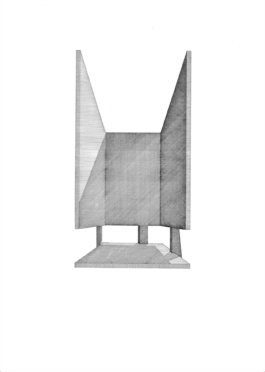
This thesis is a design-based inquiry in which drawing functions as a primary mode of knowledge production, not as representation but as an investigative tool. The process began with an intuitive series of abstract hand drawings depicting ambiguous spatial constellations. These images resist clear classification and oscillate between spatial depth and graphic surface, leaving materiality, scale, and function unclear. Through an iterative process, the drawings gradually evolved into more defined architectural representations and later into atmospheric renderings, intensifying their affective qualities. Observation and reflection on the emerging body of work led to the articulation of the research question itself: How can we design ideologically undedicated spaces that provoke the visitor to attribute individual meaning into them through their emotional resonance?
The existing drawings were then revisited, allowing recurring patterns and implicit strategies to be identified and distilled: filtered context, temporal depth, ambiguity, bodily presence, and non-propositional affordances. These principles were positioned within theoretical discourse and subsequently tested through seven speculative spaces that function as experiments to explore the validity of the findings. The research therefore positions architectural drawing as a tool of inquiry and explores the possibilities to design spaces that invite or even provoke individual interpretation rather than imposing universal meaning.
We live in a society where overarching ideological references have lost universal validity. Worldviews have become private, dogmas are questioned, and shared narratives erode. This contributes to a perceived crisis of meaning, expressed in escapism, eclectic spirituality, and rising fundamentalism, affecting social cohesion and mental well-being. Comparable ideas appear across philosophical and architectural discourse. While some thinkers interpret this as a loss, others see it as liberating. In this context, architecture is no longer bound to represent ideological truths but can express individual reflection and perception without metaphysical obligation.
This research shifts the focus from theoretical diagnosis to practice. It investigates how architecture can engage this condition through the design of non-propositional spaces that invite, or even provoke, personal attribution of meaning without relying on ideological or symbolic dedication.
This thesis is a design-based inquiry in which drawing functions as a primary mode of knowledge production, not as representation but as an investigative tool. The process began with an intuitive series of abstract hand drawings depicting ambiguous spatial constellations. These images resist clear classification and oscillate between spatial depth and graphic surface, leaving materiality, scale, and function unclear. Through an iterative process, the drawings gradually evolved into more defined architectural representations and later into atmospheric renderings, intensifying their affective qualities. Observation and reflection on the emerging body of work led to the articulation of the research question itself: How can we design ideologically undedicated spaces that provoke the visitor to attribute individual meaning into them through their emotional resonance?
The existing drawings were then revisited, allowing recurring patterns and implicit strategies to be identified and distilled: filtered context, temporal depth, ambiguity, bodily presence, and non-propositional affordances. These principles were positioned within theoretical discourse and subsequently tested through seven speculative spaces that function as experiments to explore the validity of the findings. The research therefore positions architectural drawing as a tool of inquiry and explores the possibilities to design spaces that invite or even provoke individual interpretation rather than imposing universal meaning.