Hybrid Artefacts
Transforming Abstract Drawings into Generated Architecture
Marcel Moonen
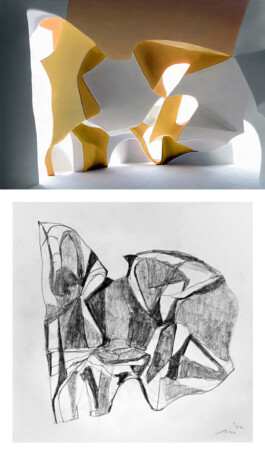
This research investigates how abstract drawings can be systematically transformed into architectural forms through AI image generation. The study introduces "Hybrid Artefacts", a distinct subcategory of design objects born from the synthesis of human intuition and machine logic. These artefacts occupy a liminal domain between author and artificial intelligence.
The methodology centres on calibrating the threshold between generative chaos and predictable control. By systematically varying parameters such as classifier-free guidance (CFG) and sampling steps, the research identifies a narrow operational band in which visually unpredictable forms occasionally emerge that achieve spatial coherence. 'Key frames' are identified through a combination of aesthetic evaluation and iterative pattern recognition across multiple generational batches. Successful parameters are then visually coded into a node-based workflow that maintains controlled unpredictability while streamlining production.
These findings are contextualised by three case studies: (1) constructing speculative narratives around these self-referential hybrid artefacts, and (2) replicating the process using abstract drawings by Hermann Finsterlin and Friedrich Kiesler. The third case study involves implementing a double transformation process: first, the abstract drawings are converted into digital models, and then these models are materialised as 3D-printed physical objects.
The resulting body of work, Artificial ~ Nature, showcases an organic architectural language that appears to have evolved naturally, rather than being digitally constructed. Artefacts that share underlying morphological patterns, creating visual coherence across diversity. The findings also demonstrate how creative agency can be shared between human and artificial intelligence, suggesting an alternative approach for design practice.
Hybrid Artefacts
Transforming Abstract Drawings into Generated Architecture
Marcel Moonen
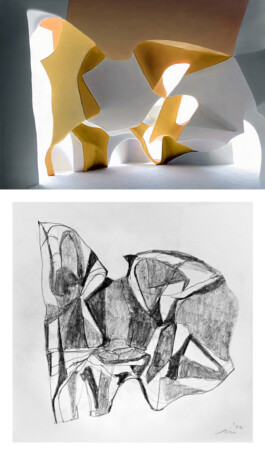
This research investigates how abstract drawings can be systematically transformed into architectural forms through AI image generation. The study introduces "Hybrid Artefacts", a distinct subcategory of design objects born from the synthesis of human intuition and machine logic. These artefacts occupy a liminal domain between author and artificial intelligence.
The methodology centres on calibrating the threshold between generative chaos and predictable control. By systematically varying parameters such as classifier-free guidance (CFG) and sampling steps, the research identifies a narrow operational band in which visually unpredictable forms occasionally emerge that achieve spatial coherence. 'Key frames' are identified through a combination of aesthetic evaluation and iterative pattern recognition across multiple generational batches. Successful parameters are then visually coded into a node-based workflow that maintains controlled unpredictability while streamlining production.
These findings are contextualised by three case studies: (1) constructing speculative narratives around these self-referential hybrid artefacts, and (2) replicating the process using abstract drawings by Hermann Finsterlin and Friedrich Kiesler. The third case study involves implementing a double transformation process: first, the abstract drawings are converted into digital models, and then these models are materialised as 3D-printed physical objects.
The resulting body of work, Artificial ~ Nature, showcases an organic architectural language that appears to have evolved naturally, rather than being digitally constructed. Artefacts that share underlying morphological patterns, creating visual coherence across diversity. The findings also demonstrate how creative agency can be shared between human and artificial intelligence, suggesting an alternative approach for design practice.